Thursday, August 1, 2024

Nordic Freeze: First Taste of Winter Wonderland


“Blessed be the Lord, the God of Israel who alone does wondrous deeds.” - Psalm 72:18

When traveling abroad and you’re not part of a tour group or have a personal tour guide with a van like we had in our Japan trip, it’s strategic to book a hotel at the city center. This is one of the most important lessons I learned in our Nordic trip: MAKE SURE OUR HOTEL IS CONVENIENTLY LOCATED.

For the Oslo leg of our journey, my elder son and I were billeted at the Anker Hotel. It was walking distance to the Oslo Central Station and there were  tram and bus stops right beside it. Eating places and convenience stores lined the street it was on. Very convenient especially upon arrival and departure with our luggage.

Waking up in our hotel with a view of the ice floating on Akerselva River further reinforced the awareness we were not in Manila anymore. (As if trudging through streets cloaked by evening’s dusky mantle at 4:00 in the afternoon was not enough to convince me the day before.)  Today is our first outing in winter wonderland.


Akerselva River

Stepping out of the hotel, we took time to marvel at the icy panorama that is Akerselva. The river flows through Oslo starting at Maridalsvannet, Oslo’s largest lake and into the Oslo Fjord. An 8-km. walk along its course goes through parks and small forests. My post trip research showed that there are historical buildings, fishing and swimming spots, waterfalls, culture and art hubs, and a foodie paradise to make the trek worthwhile. Although we saw people trudging along the riverbank, a winter walk would have been too much for tropical me. I uttered a small prayer that I may be able to visit my younger son again during summer so I can explore its banks.

Akerselva Riverbank Walk

First on our itinerary is the Norsk Folkemuseum (Norwegian Museum of Cultural History) in Bygdøy, Oslo.  

Norsk Folkemuseum The Countryside

It presents life in Norway from the 1500s and displays an extensive collection of artifacts from all social groups and regions of Norway.

Norsk Folkemuseum staff dressed as a farm girl

What made us truly feel the Norwegian way of life is the large open-air museum with 160 buildings relocated from towns and rural districts from around the country.


Historic storehouse with  ornate hand-carved wooden loft

We trudged in the snow through a Nordic countryside with farmhouses,


had a scare sliding over an icy patch as we searched for the Stave Church,

“roped the reindeer” outside a goahti or gamme (hut) in the Sámi Site (the Sámi are an indigenous Finno-Ugric people of the north),


viewed the permanent exhibits showing folk art, folk dress, church art, toys and Sámi culture in the Parliament Hall,


Norsk Folkemuseum Torget & Parliament Hall

and ate lunch by a cozy fireplace at Café Arkadia, the museum cafe.

Cafe Arkadia

Snow, snow and more snow waited for us after lunch at the Akershus Slott, a medieval fortress and castle overlooking the Oslo fjord.


It was built to protect and provide a royal residence for Oslo. At the time of our visit it was serving as the temporary office of the Prime Minister of Norway.


Standing guard at Akershus Slott

Blessed be the Lord, our God, for answered prayers and showing us this winter wonderland.


Tuesday, July 9, 2024

Nordic Freeze: Simbang Gabi in Oslo


 “Sing joyfully...the Lord, is in your midst, you have no further misfortune to fear...Fear not...be not discouraged.” - Zephaniah 3:24-16

In 2018, I prayed God would grant my wish to go on this Nordic trip. My younger son had left to work in Norway middle of that year. I wanted our small solo parent family (my two sons and I) to still be together for the Christmas holiday.

“Be specific with your prayers”, we would always be reminded in teachings. So specific me had been badgering God at my daily mass routine with the tiniest details about all my travel concerns. I wanted a stress-free perfectly perfect holiday. But it got to the point I became anxious about nothing going wrong that I developed fears for myself and my family. It became so bad that every time one of us would go out, I had insane fears of bad things happening. My chest would constrict from the anxiety.

Then a few days before our departure, my Caring Group sister, Beng, posted a reflection in our chat group. A line from it struck me: “Lord, Your Word says You desire to prosper us and not to harm us.” It was then I realized that the fear gripping me was an oppression from the evil one. Suddenly, the anxieties just vanished. And even if there were last minute stress-inducing hitches, here we were, together as a family, listening to “Simbang gabi simula ng pasko, sa puso ng lahing Pilipino...” in a church with a snow-covered courtyard. It was indeed a reason to sing, for God was, is and always will be in our midst.

St. Olav Katolske Domkirke 

Let me backtrack a bit to how our Nordic trip began.

When I travel to other countries, it takes time to register that I’m stepping out of the airport to a foreign land. As we drive to wherever we’re staying, I have to spot the difference between the Philippines and the country I’m visiting. Only when I see the dissimilarity do I feel that I’m really in a different place. I’ve been to other Asian countries, to North America and Australia but despite being in different continents, that experience never changed. Obviously, the seasons had something to do with it. I’ve only traveled during spring, summer and fall (yes, it still took time and travelling quite a bit to see leaves turning yellow in the US and Australia).

But as we landed at the Oslo Lufthavn, it already hit me that I was in alien territory. Whizzing past the plane window were grounds covered with snow and trees glistening white – a scene I will definitely not see in the Philippines. At already past 10 in the morning, the sun was just beginning to dance around in its light-yellow gown.

First glimpse of snow from the train window

Another I’m-in-a-different-continent experience was the early dusk (just after lunch) that descended upon us as we walked to the Oslo Central Station to buy transport passes and sim cards.

Oslo Subway Station

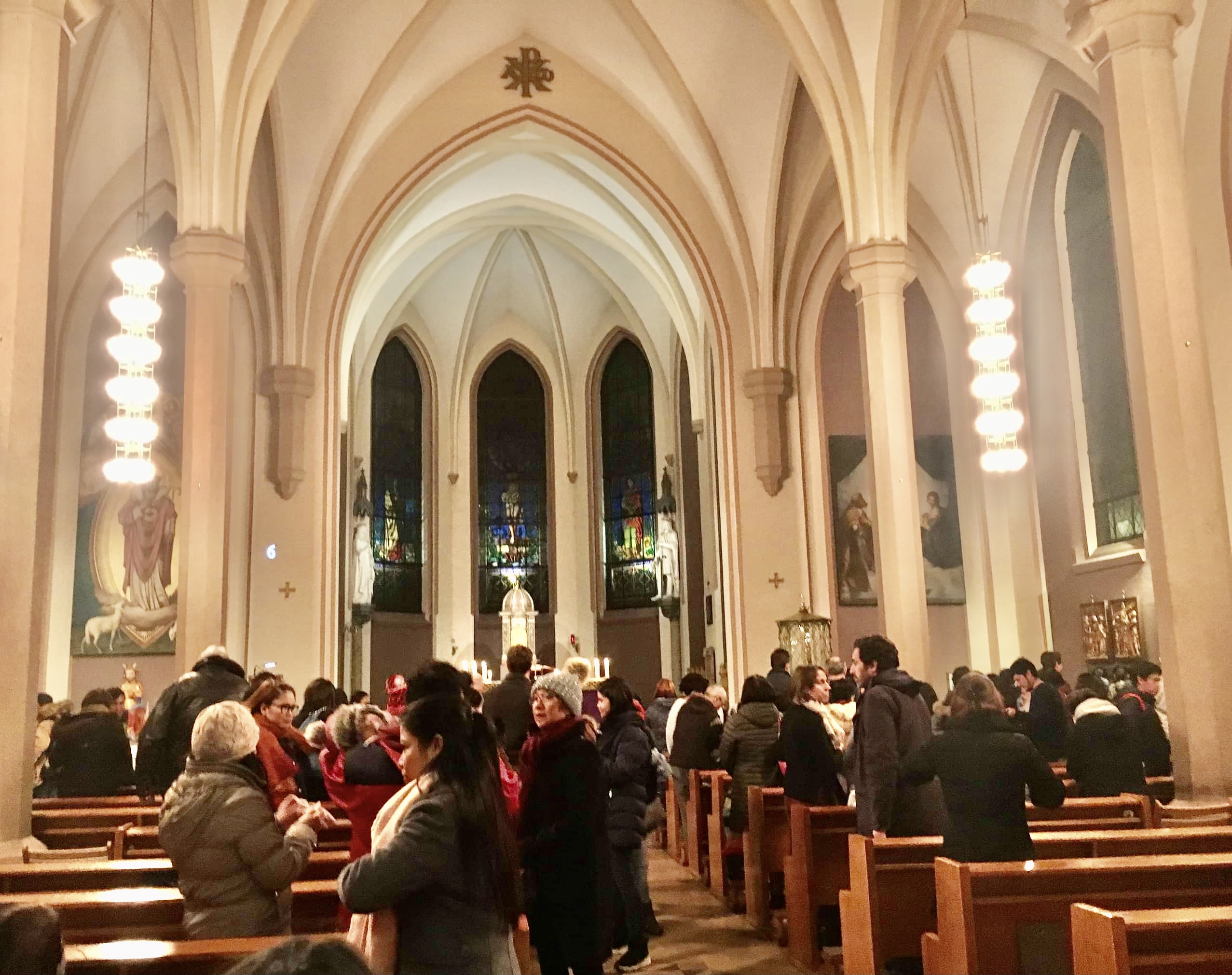
In the early evening, after dashing through the snow (well, walking briskly through snow flurries would better describe it), we got to St. Olav Katolske Domkirke (I guess that means Catholic Church). Our arrival in Oslo was a Sunday and what better way to end our first day than with a mass. It was a heartwarming experience!

My son, who is working in Oslo, did say that in the church where he attends mass, there were many Filipinos. True enough, I heard Tagalog being spoken as we entered. And the lady beside me requested, “Ate, paki reserve naman ng upuan ko. May kakausapin lang ako.” (“Sister, please reserve my seat. I just have to talk to someone.”)


Kababayans in St. Olav

What I did not expect was that about 90% of the full-packed church were our kababayans (countrymen). But more incredible was that the choir burst into song at the priest’s entrance with the very festive “Simbang Gabi” (a traditional Filipino Christmas carol). So far from home, yet I was blessed to still attend our traditional simbang gabi (night mass), the 9-day novena before Christmas. It was something I thought I’d miss because of our family’s Nordic trip to spend the holidays with my younger son.

Capping our first Nordic Freeze day was dinner at the Pink Fish in the Oslo Subway Station eating…what else but…salmon salad, salmon burger and salmon bowl. We definitely were not in Manila anymore.


Thursday, June 27, 2024

Holy Land Pilgrimage: Standing Small


Walkway to Masada

He was trying to see who Jesus was, but on account of the crowd he could not, because he was short in stature.” – Luke 19:3


Do you sometimes fail to see Jesus because of your “smallness”? Do you feel small because sin has cut you down? Does your sense of smallness come from feeling unworthy?


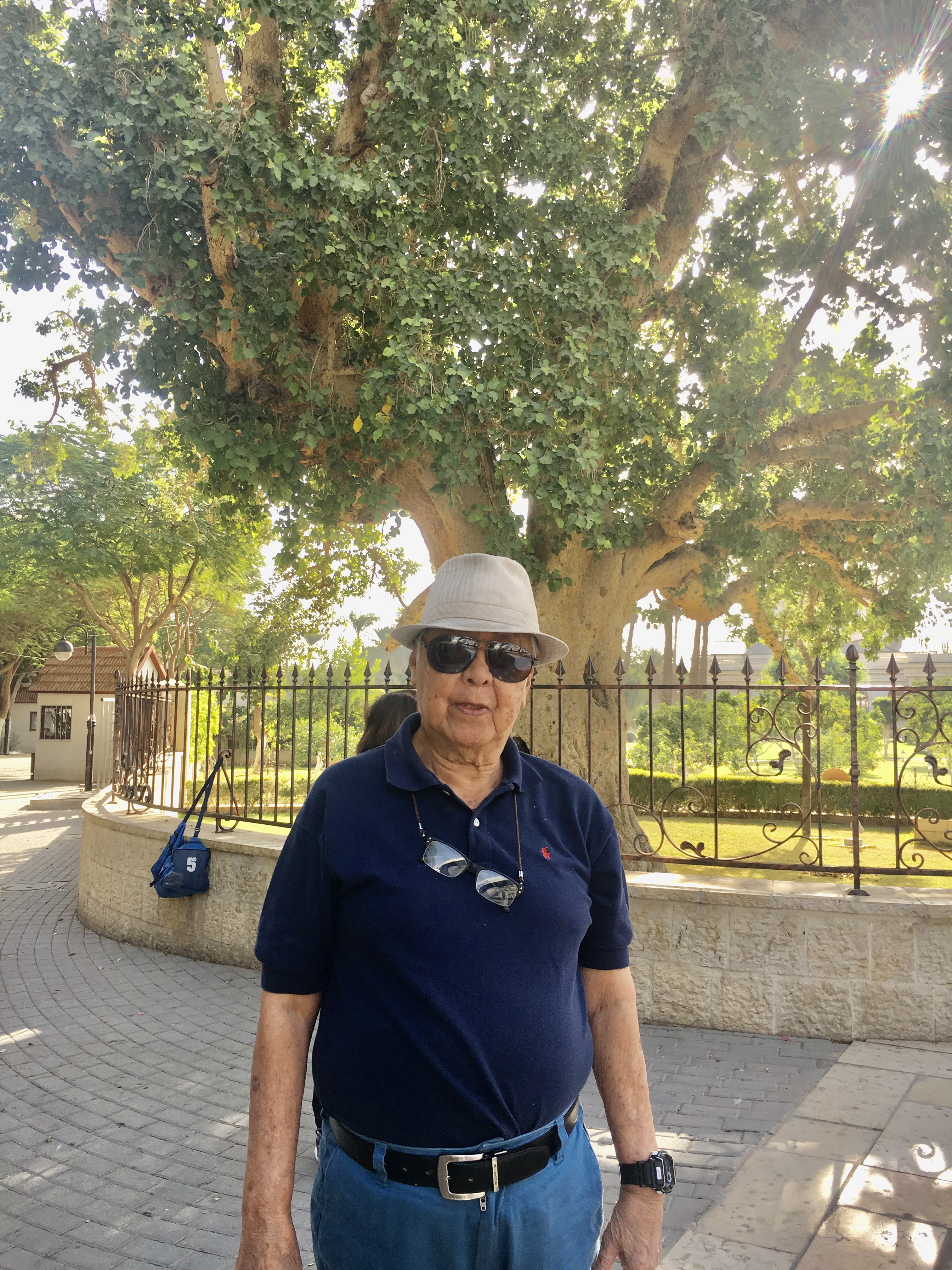
Thoughts of “smallness” were prevalent in my mind on the 10th and last day of our pilgrimage as I gazed at Zaccheus’ sycamore tree. Gazing at it reminded me of how one can stand tall despite being small – by repenting and turning over a new leaf. The sycamore tree was the first must-see spot we were brought to in Jericho.


Zacchaeus' Sycamore Tree
 

Jericho is the land promised to the Israelites. It is the first city they occupied. Our group had to cross over to Palestine to visit this oasis in the Judean Desert.


Towering above Jericho is the Mount of Temptation, the place where Jesus was tempted by the devil (Matthew 4:1-11). Gazing at the mount, I was intrigued by a structure built on its slopes. We were told it is the Greek Orthodox Monastery of Temptation. It is built above the cave believed to be where Jesus fasted for 40 days and 40 nights.


Mount of Temptation

Reflecting on the temptation of Jesus, we were reminded by our preacher that we fall not because of the situation around us but by the weakness inside us. Jesus knows who he is that’s why he overcame: He is the Son of God.


After the mount, we trooped to a building with a deck to get a good view of Tell Es-Sultan (Sultan’s Hill) or Tel Jericho, a 21-meter-high settlement mound. This UNESCO-nominated archaeological site is touted to be “the oldest town in the world” as it has its beginnings in the Neolithic Era. I wished we were down in the site rather than seeing it from a bird’s eye view as ancient things fascinate me. I like imagining what it would be like living in those times.


Tel Jericho Archaeological Site
 

Our last destination for the day and for the whole pilgrimage more than satisfied my wish to walk through vestiges of the past. We were taken up by cableway to Masada National Park.


Masada Cableway


There’s another way up to the fortress, the Snake Trail, but considering our group had super senior pilgrims, we opted to take the cableway. It afforded us a view of the Roman Siege Camp and a section of the circumvallation wall.


Snake Trail

Just the view from the walkway to the fortress was already exhilarating! Walking through the different sections of Masada was more so.


Masada

Masada (Hebrew for “Fortress”) is a UNESCO World Heritage Site on the eastern edge of the Judean Desert where Herod the Great built two palaces on top of a plateau. The scale model of the Northern Palace showed how impressive it must have been in its time.


Scale Model of the Northern Palace
 

I enjoyed meandering around the ruins by myself as walking the uneven terrain was a challenge for Papa who opted to sit with the other super seniors near the entrance. It gave me time to reflect:


Kings may be able to build strong fortresses but they will fall eventually. Only the King of Kings can keep man truly safe from all harm and evil.


After a brief walk through the Masada Museum, we came to the end of the pilgrimage. It was such a blessing to have the chance to experience the Holy Land. I count it as grace that Papa’s last international trip brought him to the land where Jesus came amongst men. As I write this he is already 93 and it will now be too taxing for him to go gallivanting abroad.


Let me just add a post script to this journey by gushing about our last night accommodation. We were pampered at the 5-star David Dead Sea Resort & Spa in Ein Bokek.


David Dead Sea Resort & Spa

Our opulent room had a panoramic view of the Dead Sea.


Our room at the David
 

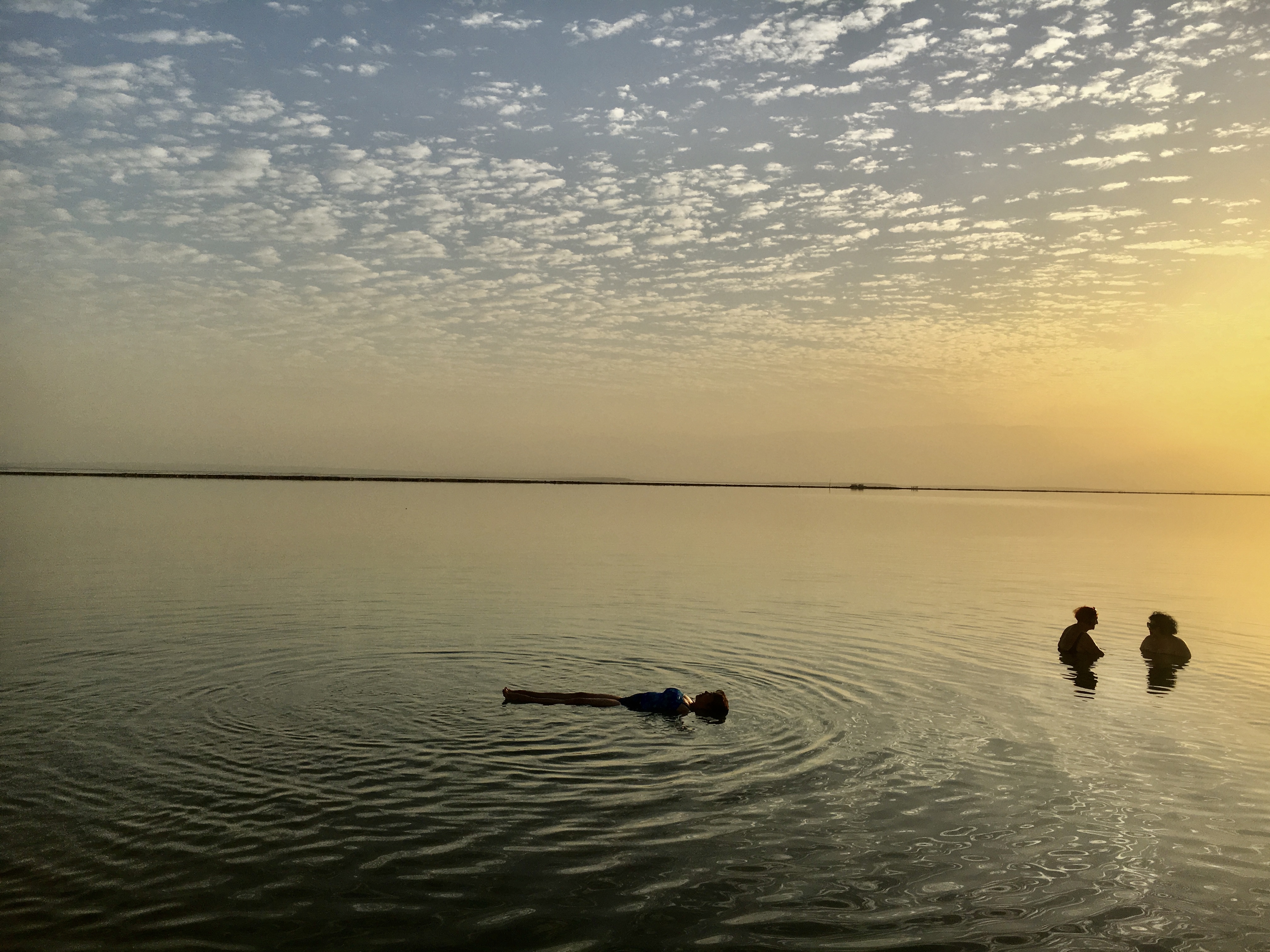
Before our flight the next day, we tested the buoyancy of the waters of the Dead Sea and rubbed ourselves with its sand for some DIY spa treatment.


Dead Sea at dawn

I can’t thank the Lord enough for allowing me and my father to be pilgrims to this Holy Land. It is my fervent prayer for peace to reign there that I may walk where Jesus walked once again. 

Saturday, May 18, 2024

Holy Land Pilgrimage: Genesis


“In the beginning was the Word, and the Word was with God, and the Word was God.” John 1:1


Day 9 of our pilgrimage was a peek into where things began, a genesis of sorts. Its highlights were a look at the life of Abraham and a glimpse at where Jesus was born.


Israel Museum


I adore miniatures. I have quite a collection of these tiny things that I picked up in my travels and some that were given to me by family and friends as souvenirs from their trips. So you can imagine my excitement when we visited the Israel Museum and I beheld a scale model of Jerusalem! The model is based on the Second Temple Period. It was a feast for the eyes of a miniature enthusiast like me. More importantly, it gave me a visual overview of Jerusalem in the time of Jesus.

Israel Museum Scale Model of Jerusalem
 

Another interesting feature of the museum is the Shrine of the Book. It is an urn-shaped building where the Dead Sea Scrolls and artifacts discovered at Masada are kept. The design of the shrine is apt as it resembles the pot where the Dead Sea Scrolls were found. Unfortunately, I do not have photos of the scrolls and the building interior as picture-taking is not allowed to preserve the artifacts.


Shrine of the Book


Genesis Land


After the museum, we were given a treat that I will never forget. We had lunch with Abraham in Genesis Land! What an experience!


Genesis Land is an oasis in the heart of the Judean desert, on the way to the Dead Sea. Eliezer, Abraham’s “main-servant”, greeted us as we trooped in to the reception area. He was dressed as we would imagine any biblical manservant should be. He oriented us about life during biblical times. Later, he asked us to don tunics to cover traces of our modern-day habiliments.


With Eliezer
 

He then led us out to “meet” our transport because we were going further into the desert to Abraham’s tent. Lounging under the noon-day sun waiting for us were camels!


Meeting our ride
 

Well, they were only for the intrepid souls. More timid ones can take the golf carts. I was feeling adventurous and didn’t want to pass up on what might be a once-in-a-lifetime experience, so I mounted one of the camels together with a co-pilgrim. I was being lulled by the gentle swaying of our ship of the desert until the path slithered to the very edge of a cliff. Then fear gripped us. A misstep by our camel could send us careening down the cliff. It did not help that Bro Arun was taking a video of us and jokingly prompted us to say our last words to our family.


By God’s grace, we reached Abraham’s Tent with no mishaps. Abraham warmly welcomed us and ushered us to sit on the floor on cushions around a low table. (The super seniors got to sit on chairs in consideration of their joint pains). Abraham graciously served us lunch. The food was sumptuous, authentic Mediterranean fare though I’m not sure if the dishes dated back to the real Abraham’s time.


Abraham serving lunch in his tent


Replete with the delicious lunch, it was time to get back on our camels for another terror-gripped ride along the cliff-side. But it was all worth it because I was given a professional camel-rider license complete with my name written in Hebrew.


My Camel Rider License


Shepherds’ Field


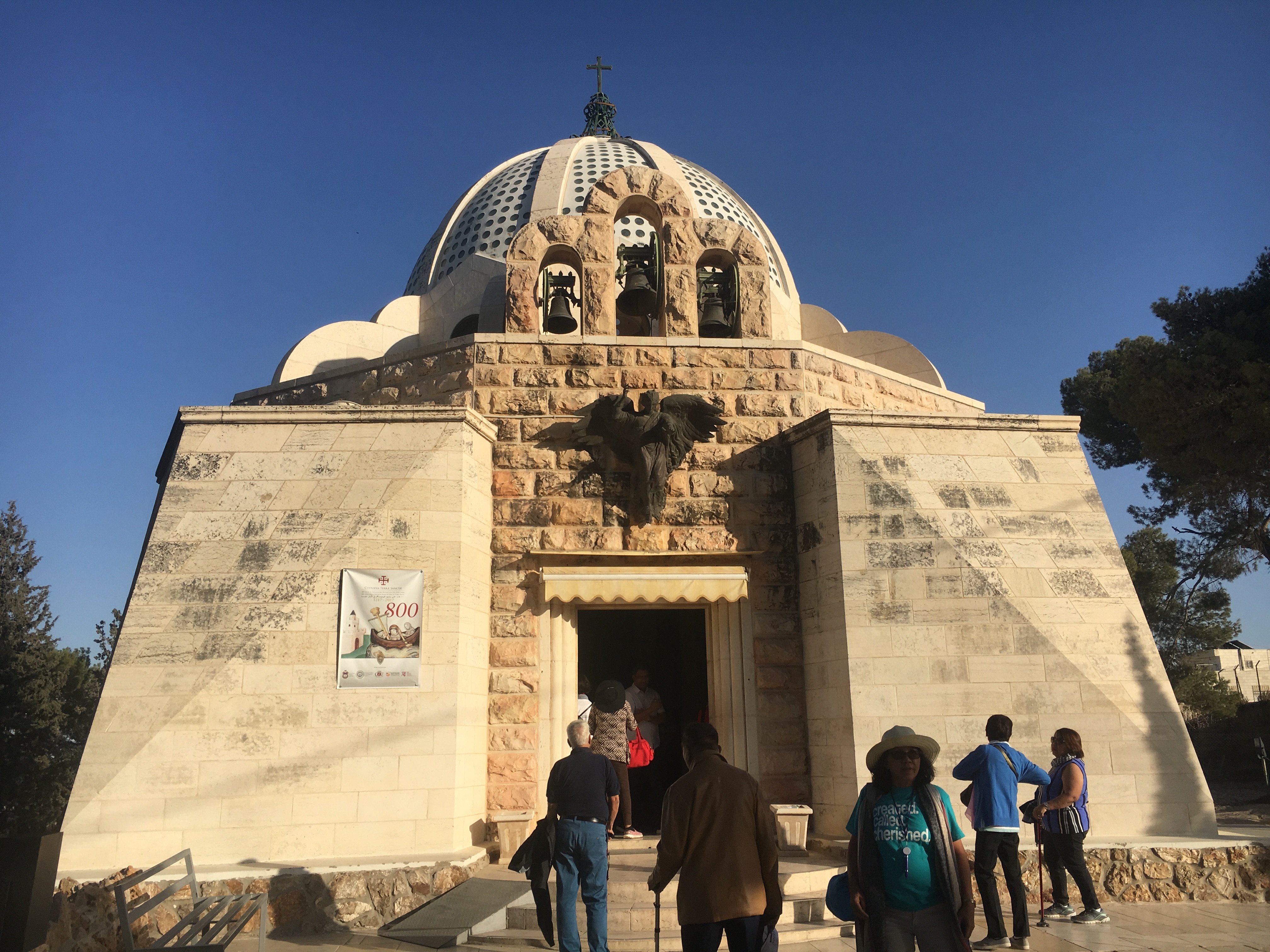
In Siyar el-Ghanam (which means Place for Keeping Sheep) is the village of Beit Sahour. It’s around 4 kilometers from the where the Nativity took place and where Shepherds’ Field sits. Here, we visited the Chapel of the Angels also known as the Chapel of Shepherds’ Field or the Sanctuary of Gloria in Excelsis Deo. The 5 apses of the church mimic a nomadic tent reminiscent of where the herders would take shelter as they tend to their sheep. It is where the angels, according to Catholic tradition, heralded the good news of Christ’s birth to them. Cast in gold on the dome above the altar are the words of the angels: Gloria in Excelsis Deo.


Chapel of the Angels
 

Beneath the main chapel is an ancient cave with soot-blackened ceiling where shepherds may have stayed. It has been converted into the Cave Chapel where pilgrims can hold services.


Church of the Nativity


More than being a UNESCO World Heritage Site, the Church of the Nativity is, for me, the Holy of Holies. It is here where mankind’s salvation began. The most profound description of the church for me is “where heaven meets earth”.


Church of the Nativity
 

We were blessed that our hotel was just near the church. We walked to Manger Square and made our way to the church which, according to Google, “is the oldest site continuously used as a place of worship in Christianity, and the basilica is the oldest major church in the Holy Land.”


Like the Church of the Holy Sepulcher, this church has mixed affiliations. Here it is mainly Greek Orthodox, Roman Catholic, Armenian Apostolic, with a minority of Coptic Orthodox and Syriac Orthodox. The main basilica is maintained by the Greek Orthodox Patriarchate.


Bending low, we entered the church through the Door of Humility which is about 4 feet high. Originally, it was so designed to prevent marauders from entering the church on horseback. But maybe, by God’s design, it is to remind pilgrims to approach this place with humility and bend our knees in submission to God’s will.


Door of Humility


As we straightened up, our eyes were drawn to traces of the medieval golden mosaics on the wall lit by sanctuary lamps. We joined the long queue of people going down to the Grotto of the Nativity, located beneath the main altar. The long wait gave us time to inspect the Iconostasis, a wall of icons and religious paintings which separated the nave from the sanctuary.


I was disappointed that the long line of people waiting behind me prevented me from truly savoring the experience of being where our Savior was born. But I still felt blessed to be able to touch the stone in the middle of the 14-point silver star. The stone is said to be the one where Mary laid Jesus after his birth.


I pensively made my way out of the grotto, taking time to peek at the original 4th century mosaic from the Constantinian basilica and thanking God for the chance to walk back through history, His Story.


To be in Bethlehem on Christmas Eve is now in my bucket list. I pray for peace in the Holy Land that God may fulfill that dream for me.