Saturday, May 18, 2024

Holy Land Pilgrimage: Genesis


“In the beginning was the Word, and the Word was with God, and the Word was God.” John 1:1


Day 9 of our pilgrimage was a peek into where things began, a genesis of sorts. Its highlights were a look at the life of Abraham and a glimpse at where Jesus was born.


Israel Museum


I adore miniatures. I have quite a collection of these tiny things that I picked up in my travels and some that were given to me by family and friends as souvenirs from their trips. So you can imagine my excitement when we visited the Israel Museum and I beheld a scale model of Jerusalem! The model is based on the Second Temple Period. It was a feast for the eyes of a miniature enthusiast like me. More importantly, it gave me a visual overview of Jerusalem in the time of Jesus.

Israel Museum Scale Model of Jerusalem
 

Another interesting feature of the museum is the Shrine of the Book. It is an urn-shaped building where the Dead Sea Scrolls and artifacts discovered at Masada are kept. The design of the shrine is apt as it resembles the pot where the Dead Sea Scrolls were found. Unfortunately, I do not have photos of the scrolls and the building interior as picture-taking is not allowed to preserve the artifacts.


Shrine of the Book


Genesis Land


After the museum, we were given a treat that I will never forget. We had lunch with Abraham in Genesis Land! What an experience!


Genesis Land is an oasis in the heart of the Judean desert, on the way to the Dead Sea. Eliezer, Abraham’s “main-servant”, greeted us as we trooped in to the reception area. He was dressed as we would imagine any biblical manservant should be. He oriented us about life during biblical times. Later, he asked us to don tunics to cover traces of our modern-day habiliments.


With Eliezer
 

He then led us out to “meet” our transport because we were going further into the desert to Abraham’s tent. Lounging under the noon-day sun waiting for us were camels!


Meeting our ride
 

Well, they were only for the intrepid souls. More timid ones can take the golf carts. I was feeling adventurous and didn’t want to pass up on what might be a once-in-a-lifetime experience, so I mounted one of the camels together with a co-pilgrim. I was being lulled by the gentle swaying of our ship of the desert until the path slithered to the very edge of a cliff. Then fear gripped us. A misstep by our camel could send us careening down the cliff. It did not help that Bro Arun was taking a video of us and jokingly prompted us to say our last words to our family.


By God’s grace, we reached Abraham’s Tent with no mishaps. Abraham warmly welcomed us and ushered us to sit on the floor on cushions around a low table. (The super seniors got to sit on chairs in consideration of their joint pains). Abraham graciously served us lunch. The food was sumptuous, authentic Mediterranean fare though I’m not sure if the dishes dated back to the real Abraham’s time.


Abraham serving lunch in his tent


Replete with the delicious lunch, it was time to get back on our camels for another terror-gripped ride along the cliff-side. But it was all worth it because I was given a professional camel-rider license complete with my name written in Hebrew.


My Camel Rider License


Shepherds’ Field


In Siyar el-Ghanam (which means Place for Keeping Sheep) is the village of Beit Sahour. It’s around 4 kilometers from the where the Nativity took place and where Shepherds’ Field sits. Here, we visited the Chapel of the Angels also known as the Chapel of Shepherds’ Field or the Sanctuary of Gloria in Excelsis Deo. The 5 apses of the church mimic a nomadic tent reminiscent of where the herders would take shelter as they tend to their sheep. It is where the angels, according to Catholic tradition, heralded the good news of Christ’s birth to them. Cast in gold on the dome above the altar are the words of the angels: Gloria in Excelsis Deo.
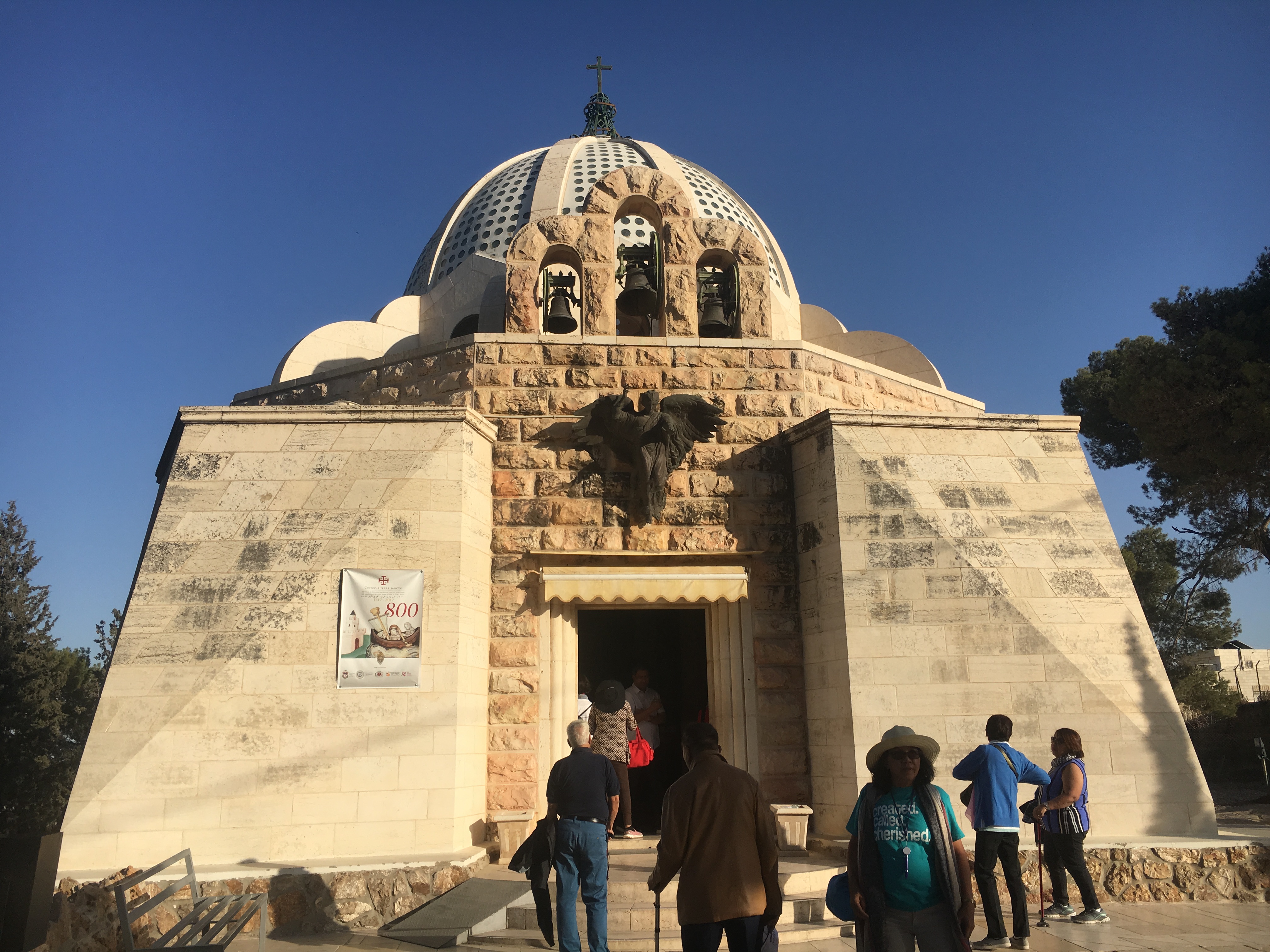

Chapel of the Angels
 

Beneath the main chapel is an ancient cave with soot-blackened ceiling where shepherds may have stayed. It has been converted into the Cave Chapel where pilgrims can hold services.


Church of the Nativity


More than being a UNESCO World Heritage Site, the Church of the Nativity is, for me, the Holy of Holies. It is here where mankind’s salvation began. The most profound description of the church for me is “where heaven meets earth”.


Church of the Nativity
 

We were blessed that our hotel was just near the church. We walked to Manger Square and made our way to the church which, according to Google, “is the oldest site continuously used as a place of worship in Christianity, and the basilica is the oldest major church in the Holy Land.”


Like the Church of the Holy Sepulcher, this church has mixed affiliations. Here it is mainly Greek Orthodox, Roman Catholic, Armenian Apostolic, with a minority of Coptic Orthodox and Syriac Orthodox. The main basilica is maintained by the Greek Orthodox Patriarchate.


Bending low, we entered the church through the Door of Humility which is about 4 feet high. Originally, it was so designed to prevent marauders from entering the church on horseback. But maybe, by God’s design, it is to remind pilgrims to approach this place with humility and bend our knees in submission to God’s will.


Door of Humility


As we straightened up, our eyes were drawn to traces of the medieval golden mosaics on the wall lit by sanctuary lamps. We joined the long queue of people going down to the Grotto of the Nativity, located beneath the main altar. The long wait gave us time to inspect the Iconostasis, a wall of icons and religious paintings which separated the nave from the sanctuary.


I was disappointed that the long line of people waiting behind me prevented me from truly savoring the experience of being where our Savior was born. But I still felt blessed to be able to touch the stone in the middle of the 14-point silver star. The stone is said to be the one where Mary laid Jesus after his birth.


I pensively made my way out of the grotto, taking time to peek at the original 4th century mosaic from the Constantinian basilica and thanking God for the chance to walk back through history, His Story.


To be in Bethlehem on Christmas Eve is now in my bucket list. I pray for peace in the Holy Land that God may fulfill that dream for me. 

Wednesday, November 1, 2023

Holy Land Pilgrimage: Visitation


(Part 2 of Day 8)

As I write this blog, I’m feeling a bit emotional. Thoughts that the holy places we visited on our pilgrimage might be wiped out forever. Thoughts that the people we met or just encountered there might be living in fear right now. Sad thoughts. I know all things will pass as Jesus said in Matthew 24:35 – “Heaven and earth will pass away, but my words will never pass away.” But I just wish not in this violent way and not in my lifetime. I would love to visit the Holy Land again.


Before these holy sites pass away, come visit them with me as I continue to record the rest of the 8th day of our pilgrimage. In my previous blog, I narrated our experience walking the Via Dolorosa.


After tracing the Way of the Cross, we meandered through Souk el-Dabbagha, the Old City Bazaar outside the Church of the Holy Sepulcher. I wish we had more time to inspect the spices and food strange to my eyes and probably my palate. There were also souvenirs that escaped my wallet because we didn’t have time to shop as we were off to lunch. 


Old City Bazaar

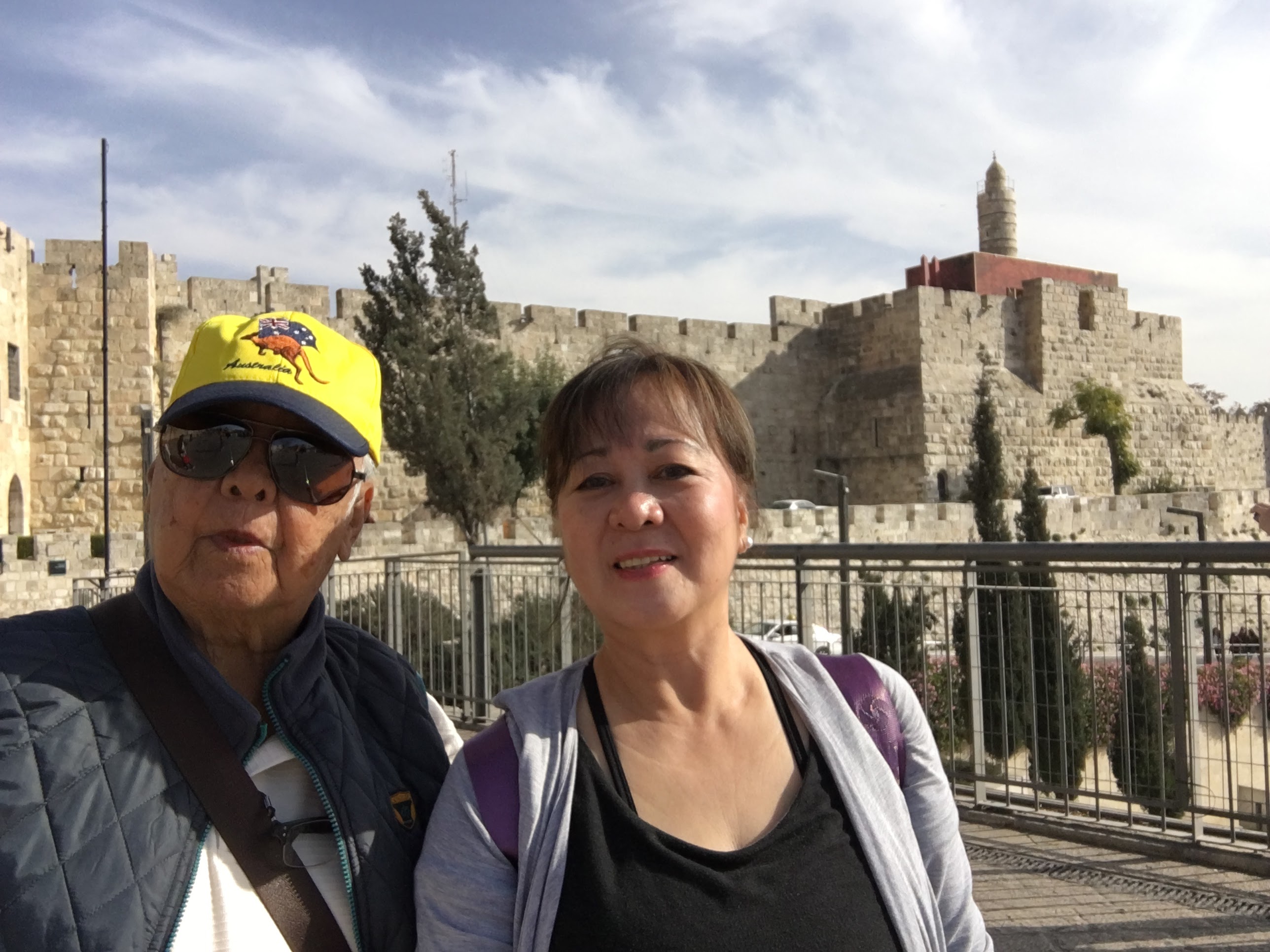
After that we exited Jerusalem through the Jaffa Gate, one of the most picturesque gates dating back to the 16th century.


Wall of the Old City of Jerusalem with
Jaffa Gate and the Tower of David

Our afternoon was spent in Ein Kerem, the hill country where the Church of the Visitation sits on the site of Zechariah and Elizabeth’s summer house. It was a long and tiring climb up to the church even if the stairs weren’t steep. Our super senior co-pilgrims stayed in the garden at the bottom of the hill and just enjoyed an ice cream treat from our tour organizer, my cousin Belle.


Steps to the Church of the Visitation
This two-tiered Catholic church commemorates the Visitation. On its façade is the mosaic of Mary on her way to visit Elizabeth.


We got to see the upper church but only got a peek at the lower church as there was a mass going on.


Altar & frescoes of the Upper Church
 

In the Courtyard are ceramic plaques of Mary’s Magnificat (Canticle of Praise) in 42 languages.


Going back downhill, we next visited the Church of the Nativity of St. John the Baptist or St. John Ba Harim (St. John of the Mountains). The church is also Catholic, this one built on the site of the house in the valley where St. John was born.


It was a long and tiring day, but several of us could not pass up the chance to visit the Wailing Wall or Ha-Kotel. The ancient limestone wall is just a portion of a longer ancient one known as the Western Wall because it is located at the western side of the Temple Mount. It is the holiest place for the Jews where they go to pray. There were some interesting things I learned on our visit there:

  • ·        Jewish custom dictates one should never turn one’s back to the Wall. People have to walk backwards as they exit.
  • ·        In the Western Wall Plaza, there are fountains for ritual hand washing where you have to cleanse before entering.
  • ·        Women have a separate section where they can pray.

We also took a tour of the Western Wall Tunnel where we saw the Master Course stone. It is the largest of the Herodian ashlars measuring 41 feet long x almost 12 feet high x 14 feet deep, weighing almost 600 tons. Also inside the tunnel is the Struthion Pool, a cistern built by Herod the Great, and a scale model of the Temple Mount.


Wailing Wall
 

Although the Wailing Wall is not part of our pilgrimage, it was still a site we wanted to view, to experience and understand the Jewish side of Jesus.

Thursday, October 19, 2023

Holy Land Pilgrimage: Carrying our Cross


I couldn’t believe it! It’s been almost a year since I wrote this blog. Aside from the many things that happened, I’ve been focusing on my faith blog and didn’t have the chance to finish this. But I always say God’s timing is perfect. Things happen when He wants them to happen. It is with both gratitude and sadness that I reminisce on our Holy Land trip. Gratitude for the chance to visit the place where Jesus walked before all the hostilities happened. Sadness because of the war going on in Israel right now. I pray for peace, that the Israelites and Palestinians will learn to live in harmony. I also pray that the holy sites may not be affected so that many more people will still get to see them and remember that it was here where God sent His only son to live among men.


With that being said, let’s continue the journey.


VIA DOLOROSA

On the 8th day of our pilgrimage, we not only followed Jesus’ footsteps, but we also carried His cross. Our whole morning was spent in Jerusalem tracing the Via Dolorosa, a processional 600-meter route in the Old City of Jerusalem from the former Antonia Fortress to the Church of the Holy Sepulcher. After entering the city through Herod’s gate,


we made our way to the Church of Flagellation, site of the 1st Station, where we were given a wooden cross to carry. Each group took turns in carrying it as we prayed the Stations of the Cross around the streets of the Jerusalem market.


“As they were coming out, they found a man of Cyrene named Simon, whom they pressed into service to bear His cross.” – Matthew 27:32


A sob almost escaped my throat when we took our turn at the cross. Unlike Simon of Cyrene, we were willing to carry this burden. Connecting with Jesus by carrying His cross made me emotional. Experiencing how Jesus was rejected by the people cut deep. Before we started, Bro Arun Gogna told us to take note of our surroundings. It is exactly as it was in Jesus’ time – a marketplace where people ignored his suffering as he carried the cross. True enough, we too were ignored. People passed by without throwing a glance at our group, sometimes shoving us a bit in their rush to overtake us.


Along the bustling streets of the Old City, we solemnly made our way passing the 2nd to the 8th Stations:

    • 2nd Station – Church of the Condemnation and Imposition of the Cross
    • 3rd Station – Armenian Polish Catholic Church
    • 4th Station – Armenian Church of Our Lady of the Spasm
    • 5th Station – Franciscan Chapel of Simon of Cyrene
    • 6th Station – Greek Catholic Church of the Holy Face
    • 7th Station – Franciscan chapel
    • 8th Station – Chapel of St. Charalampos


At the entrance to the Ethiopian Orthodox Monastery (Deir Al-Sultan) and the Coptic Orthodox Monastery of Saint Anthony where the 9th Station marker was, we had to leave the cross. These 2 churches together form the roof of the Church of the Holy Sepulcher.


Monk guarding the entrance to the Ethiopian Orthodox Monastery at Deir Al-Sultan


We descended from the roof and followed a circuitous route through the bazaar to reach the Parvis or the courtyard facing the entrance of the Church of the Holy Sepulcher. The 10th Station is in the Chapel of the Franks (also called Chapel of the Torment, Chapel of the Seven Sorrows of the Blessed Virgin Mary or Our Lady of Sorrows) which was accessible from the Parvis.  


We then entered the Church of the Holy Sepulcher (also known as Church of the Resurrection or Church of the Anastasis). It is a magnificent edifice shared by different Christian denominations. The main building has chapels run by the Greek Orthodox, Roman Catholic (called Latins in Israel) and Armenian Apostolic churches. The Coptic Orthodox (Egyptians), Syriac Orthodox, Ethiopian Orthodox churches occupy other parts of the church. An interesting trivia about this set up is that the key is kept by a Muslim to keep the peace.


Joining a throng of pilgrims, we climbed the stairs to Calvary where the 11th to the 13th Stations were located:

    • 11th Station - Catholic Chapel of the Nailing to the Cross

Above the altar: 12th century mosaic of Jesus being nailed to the cross

    • 12th Station - Greek Orthodox Chapel of the Crucifixion’s Altar where the rock of Calvary is encased in protective glass
    • 13th Station – Catholic altar of Our Lady of Sorrows


Finally, we made our way down to the 14th Station at the Edicule, a 19th century shrine where the empty tomb of Jesus is enclosed. It is in the Rotunda under the Dome of the Anastasis.


The spot that intensified the sense of Jesus’ suffering for me was the Stone of Anointing or Stone of Unction where Jesus’ body is said to have been laid after He was brought down from the cross and anointed before burial. As I gazed at the 3-part mosaic depicting the Descent from the Cross, Anointing of Jesus’ Body, Burial of Jesus on the wall beside the slab, I was one in sorrow with the Blessed Mother and His disciples.


Stone of Anointing


Our morning tracing the Via Dolorosa made us keenly aware of what Jesus suffered for our sake.


I’ll tell you about the other places we visited on our 8th day in my next blog as I feel Christ’s Passion deserves to be experienced on its own even virtually by my readers.